1. Which Printing Method Actually Lasts the Longest?
Ask five different t-shirt printers in the UAE, and you will get five different answers. The traditional screen printer will swear by plastisol ink. The modern digital shop will tell you DTF is superior. The corporate uniform supplier will insist embroidery is the only permanent solution. And the teamwear manufacturer will tell you sublimation outlasts them all.
The truth is: no single decoration technique is the best for every garment.
Durability is not an isolated metric. It is the result of chemical and mechanical compatibility between the decoration medium (ink, thread, or dye) and the underlying fabric (cotton, polyester, or blend), combined with how the garment is washed in the UAE.
2. Screen Printing: The Proven High-Volume Champion
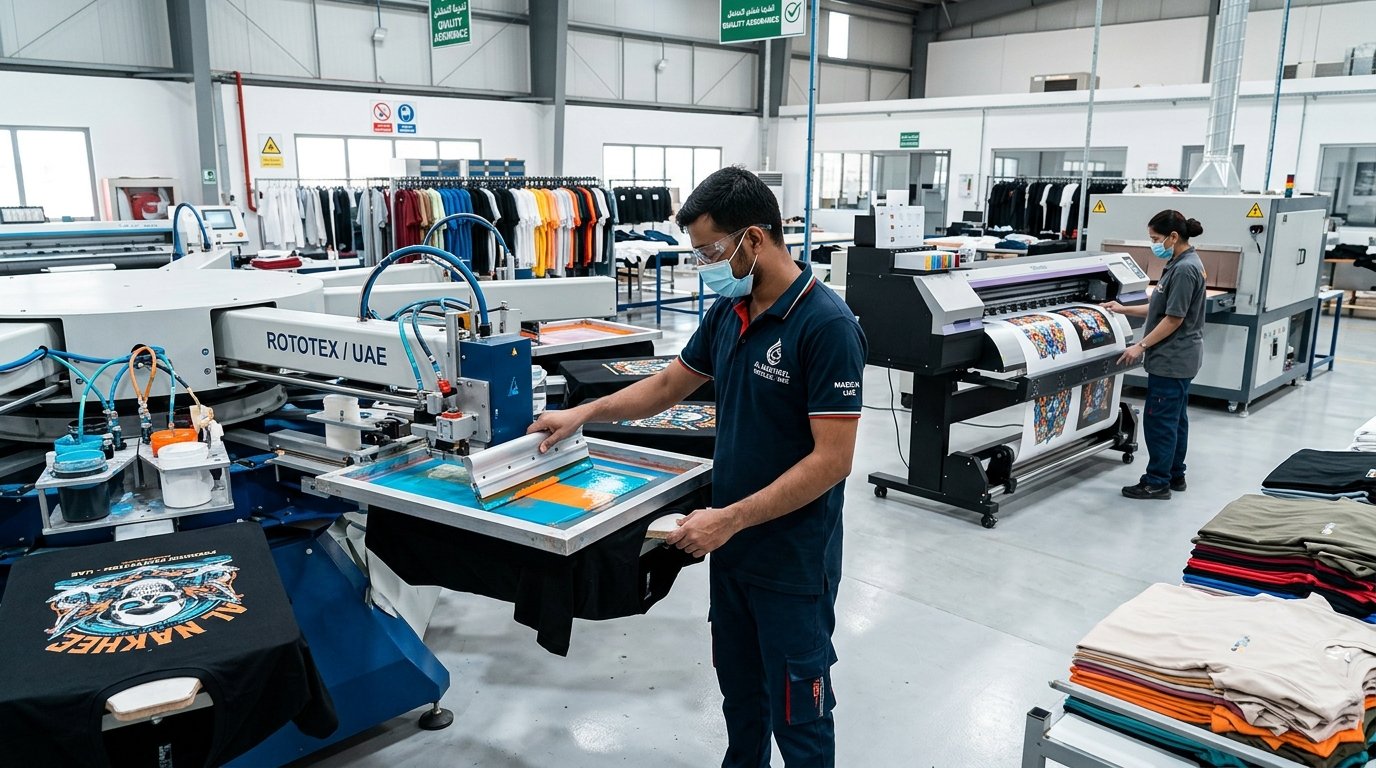
Screen printing pushes ink through a mesh stencil onto the fabric surface, followed by conveyor oven curing at 160°C. When plastisol or discharge ink cures correctly, it forms a mechanical bond with the cotton yarns.
- Exceptional wash durability: Can easily withstand 50 to 80 washes without noticeable color loss when washed in cold water.
- Unbeatable bulk economics: Once screens are exposed, printing 500 or 5,000 shirts is fast and significantly cheaper per piece.
- Exact Pantone matching: Inks can be precisely hand-mixed to match official brand PMS codes.
- Expensive setup costs for small orders (each color requires a dedicated screen).
- Complex multi-color photographic gradients are difficult to reproduce.
3. DTF (Direct-to-Film): The Digital Game Changer
DTF prints full-color artwork onto a specialized PET film using CMYK + white digital textile inks, followed by an adhesive powder shaker and thermal heat press transfer.
- Photographic detail & fine gradients: Reproduces drop shadows, glow effects, and hyper-detailed illustrations effortlessly.
- Zero screen setup fees: Perfect for smaller batch drops (25 to 150 pieces) and multi-color startup brand graphics.
- Universal fabric adhesion: Bonds strongly to 100% cotton, poly-cotton, French terry, and performance blends.
- Strong elasticity: Modern premium TPU adhesive powder stretches with the fabric without cracking.
4. Computerized Embroidery: The Indestructible Prestige Standard
Embroidery does not rely on ink adhesion or adhesive powder. It uses computerized multi-head Tajima machinery to physically stitch tens of thousands of high-tensile polyester or rayon threads through the fabric.
Corporate polo shirts, fleece hoodies, executive jackets, and caps. Thread colors will outlast the fabric itself—resisting commercial laundry, heavy friction, and hundreds of wash cycles.
High stitch density adds physical weight and tension. On t-shirts under 170 GSM, embroidery will cause the fabric to puck and wrinkle. Always pair embroidery with 180+ GSM cotton or piqué knits.
5. Dye Sublimation: Permanent Molecular Infusion for Sportswear
Unlike screen printing or DTF (which lay on top of the fabric), sublimation turns solid dye into a gas at 200°C, bonding molecularly with the polyester fibers.
Because the dye becomes the fiber itself:
- It has zero hand feel: The fabric remains completely soft, flexible, and 100% breathable.
- It physically cannot crack or peel: There is no adhesive layer or ink film to deteriorate.
- The caveat: It only works on white or light-colored 100% polyester. It cannot be used on dark garments or cotton.
6. The 10-Point Master Comparison Matrix
| Feature | Screen Printing | Direct-to-Film (DTF) | Embroidery | Dye Sublimation |
|---|---|---|---|---|
| Wash Life | 50+ Washes | 40–60 Washes | Permanent (100+) | Permanent (100+) |
| Cracking Risk | Low (if properly cured) | Low (flexible TPU) | None | None |
| Color Limits | 1–6 Spot Colors | Unlimited (Full CMYK) | Up to 12 Thread Colors | Unlimited (Full CMYK) |
| Hand Feel | Soft to Medium | Smooth thin film | Textured 3D stitch | Zero (Raw fabric feel) |
| Setup Fees | Screen setup per color | None | One-time stitch digitization | None |
| Fabric Compatibility | Cotton & Blends | Universal (Cotton, Poly, Fleece) | 180+ GSM Heavy Cotton, Polos | 100% Polyester Only |
| Best Order Size | 100 to 10,000+ Units | 25 to 250 Units | 25 to 500+ Units | 25 to 5,000+ Units |
7. Cost vs Order Volume Economics
Understanding the breakeven curves saves procurement teams thousands of dirhams:
For smaller team drops or events needing multi-color logos, DTF avoids screen origination fees (typically AED 75–120 per screen color). The per-unit price remains steady and highly cost-efficient.
Once order volume exceeds 250 units with 1 to 3 spot colors, screen printing production costs drop dramatically. On a 1,000-piece order, screen printing is substantially more economical per garment than digital transfers.
8. Frequently Asked Questions
Does DTF printing peel or crack in UAE washing machines? expand_more
Not when applied with commercial pneumatic heat presses and premium TPU melt adhesive. At Neyatek, all DTF prints undergo double-cure press cycles (15 seconds initial bond + 10 seconds post-seal press). They withstand 40–50 standard 30°C domestic wash cycles with zero peeling.
Can you embroider thin t-shirts? expand_more
We strongly advise against embroidering shirts under 170 GSM. The tight thread tension pulls on lightweight cotton, causing the fabric to puck around the logo. For thin summer tees, choose DTF or screen printing. Save embroidery for polos, hoodies, and 200+ GSM heavyweight tees.
Can I sublimate on black or navy shirts? expand_more
No. Sublimation dye is transparent and has no white ink layer. If applied to dark polyester, the design will disappear into the background. For dark garments, use Screen Printing, DTF, or Embroidery.